YoungShakespeare.fyi
We believe the ‘Bad’ Quartos are good — and that they were all written by Shakespeare as a young man.
For more than a century the earliest printed texts of several of Shakespeare’s plays have been dismissed as pirated, misremembered copies. This site sets out the evidence that they are something else: Shakespeare’s own first versions, later revised and enlarged by the author himself.
The orthodox view
What is the ‘Bad Quarto’ theory?
Several of Shakespeare’s plays first reached print as short, cheap quarto editions whose texts differ sharply from the longer versions printed later. In 1909 the bibliographer A. W. Pollard grouped the most troublesome of them together as the ‘bad quartos’: corrupt editions, as he saw them, put into print without the consent of the author or his company. The list usually given today is The First Part of the Contention (1594), The True Tragedy of Richard Duke of York (1595), Romeo and Juliet (1597), Henry V (1600), The Merry Wives of Windsor (1602) and Hamlet (1603).
Hamlet’s first quarto met hostility from the moment it reappeared. Its existence had been unknown for two centuries; when a copy was found in 1823, the first public announcement, in The Literary Gazette of January 1825, greeted it with dismay:
“Every person of literary taste must wonder, and every enthusiastic admirer of Shakespeare be inclined to utter an exclamation of dismay, when we lay before them the contents of this precious book.”
The same notice suggested that the play had been “picked out by hearing it performed, and getting speeches and parts from some of the actors.” That suspicion grew into a theory. To explain how a short text could agree with Shakespeare’s in some places and depart from it in others, scholars proposed that it had been put together by people other than the author:
- Memorial reconstruction: actors who had played in the piece wrote it down from memory, recalling their own parts well and the rest badly. W. W. Greg made this case for The Merry Wives of Windsor in 1910, and G. I. Duthie applied it to Hamlet in 1941.
- Shorthand: a member of the audience took the play down in shorthand during a performance.
- Abridgement: the full play was cut down for touring or for a smaller cast, with a ‘hack poet’ patching the gaps.
Combined, these ideas made the short quartos derivative by definition: corruptions of a single ‘perfect’ original, never earlier drafts of it. Through the twentieth century this became the settled orthodoxy, and most modern editions still describe these texts as reported or adapted versions. It has not gone unchallenged. Since the 1990s scholars such as Laurie Maguire and Paul Werstine have argued that the evidence for memorial reconstruction is far weaker than it was once thought to be, and a minority of critics, Eric Sams most forcefully, have defended the quartos as Shakespeare’s own work. The 200th anniversary of the discovery of Hamlet Q1, in 2023, passed without the consensus moving.
Our view
Why we do not accept it
None of the reporters, shorthand writers or hack poets in the theory is recorded anywhere; they were invented to explain the texts. The texts themselves point another way.
A memory keeps words, not spellings, and a shorthand writer records speech, which has no spelling at all. Yet Hamlet Q1 shares hundreds of Shakespeare’s own peculiar spellings, letter for letter, with the Second Quarto of 1604–5, which everyone agrees was printed from his manuscript, and with the First Folio of 1623. More than that, Q1 sometimes agrees with Q2 against the Folio, and sometimes with the Folio against Q2. That is the pattern of a text that descends from a written original, not one rebuilt from a performance.
We read the short quartos as what the Second Quarto of Hamlet says they are: earlier versions, later “enlarged to almost as much againe as it was.” A Hamlet was already on the stage by 1589, when Thomas Nashe mocked writers of “whole Hamlets”. Orthodox scholarship gives that early play to someone else, usually Thomas Kyd. We think it was Shakespeare’s own, and that the ‘bad’ quartos show us the young Shakespeare at work.
See the evidence
Check it for yourself
Everything argued here can be checked against the original spellings. Start with the concordance, or open one of the colour-coded facsimiles.
The Early Quartos Concordance
423,698 words from 21 early quartos, from Titus Andronicus (1594) to Othello (1622), searchable word by word in their original spellings.
Search the concordance →Hamlet Q1, 1603
All 2,222 lines of the First Quarto, each shared spelling coloured gold, green or blue according to whether it reappears in Q2, the Folio, or both.
Read the facsimile →Romeo & Juliet Q1, 1597
‘An excellent conceited Tragedie’: the First Quarto, coloured to show the spellings it shares with the Second Quarto of 1599 and the Folio.
Read the facsimile →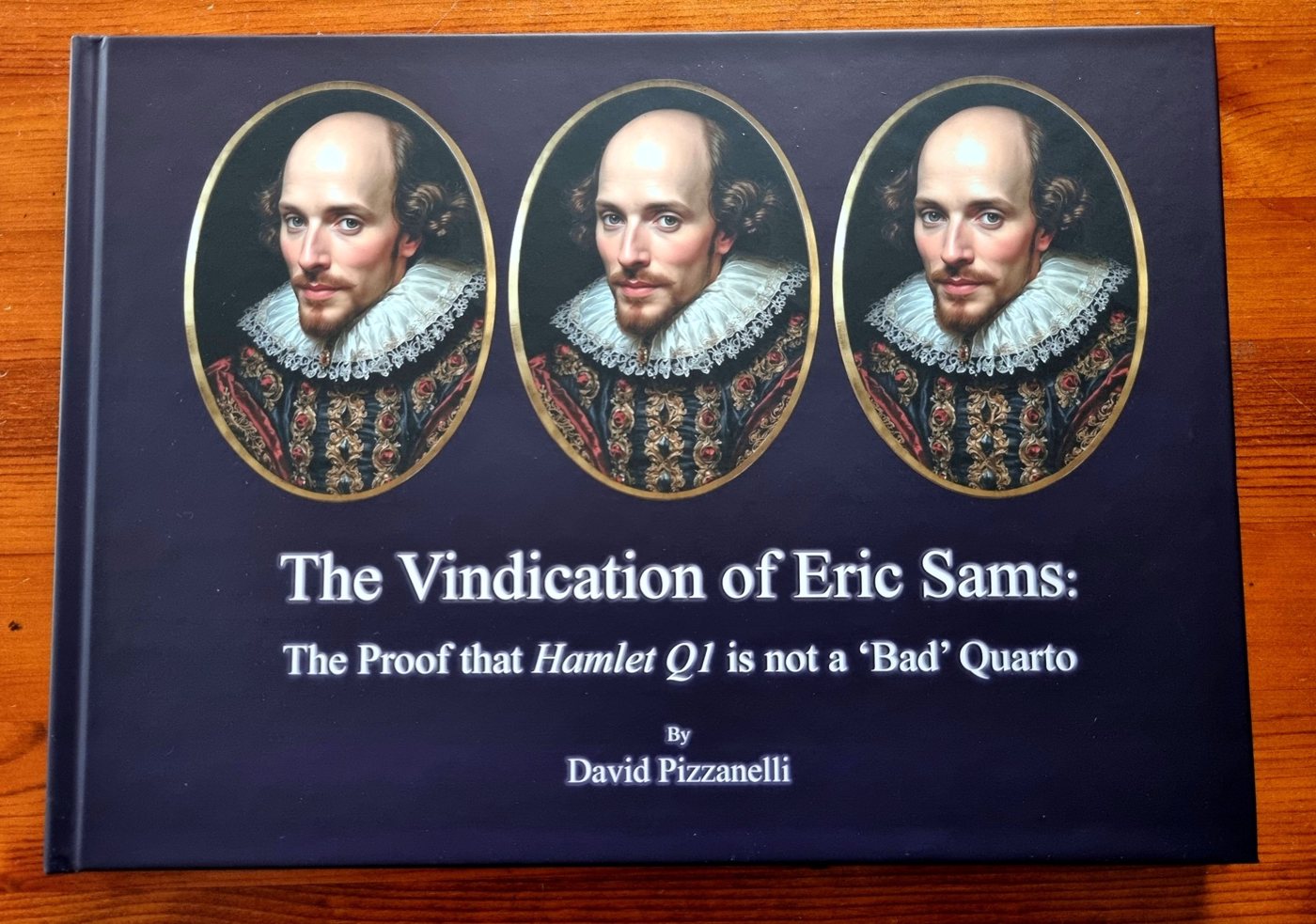
Coming soon
The Vindication of Eric Sams
The Proof that Hamlet Q1 is not a ‘Bad’ Quarto
- Signed
- Numbered
- Limited edition
- Not for profit
In 1998 Eric Sams published a short paper in Hamlet Studies with a long claim inside it: that Hamlet Q1, for two hundred years written off as a pirate’s botch, was set from Shakespeare’s own manuscript. His evidence was spelling. Q1 has the same eccentric forms as the Second Quarto, which everyone grants was printed from Shakespeare’s autograph, and Sams counted “about six hundred separate Shakespearisms” shared between them.
Sams counted by eye, from printed concordances, and said the work would one day be done again by computer. This book does it. Every one of Q1’s 2,222 lines is set beside the lines of Q2 and the Folio that answer it, and every shared spelling is coloured. Sams’s categories are tested one by one, against a stricter rule than he used, and he is confirmed on every count.
The book then goes further. A fingerprint proves that the same hand touched two documents, but not which came first. Q1 agrees with Q2 against the Folio in some places and with the Folio against Q2 in others. That pattern, which the book calls bibliographical DNA, places Q1 in the family tree of the play, before Q2 and F1, not after them. A second, independent line of evidence comes from the use of capital letters in mid-line.
The book will be a signed, numbered, limited edition, planned for sale through Amazon at the cost of printing plus fees: it is a not-for-profit edition. The number of copies has not yet been fixed and will depend on how much interest there is, so if you would like a copy, please register below. There is no obligation to buy.
About the author
David Pizzanelli
As an undergraduate at Churchill College, Cambridge, David Pizzanelli directed a production of Hamlet Q1 in the Wolfson Theatre in June 1977, billed as the first Cambridge University performance in over 350 years. His dissertation, which argued that Shakespeare revised Hamlet Q1 twice before the printing of Q2, was awarded a First. After a career in holography from 1980 to 2020, he has returned to Hamlet, to show that, far from being a ‘bad’ quarto, the Hamlet of 1603 is the first version of the play, written by William Shakespeare.